Monday, October 28, 2013

Stories give rise to tradition, imagination,and reflection

I obviously procrastinate.

This means that I have not written a blog post in quite a while now.  HOWEVER, who would have thought that the past couple blogs I've missed happen to connect to each other beautifully in one magnificent mega-post?

Well, I definitely didn't, and frankly, I am extremely thankful that they do.

So, here it goes.

There was a passage in the Storyteller that really stood out to me:

"Going back in time from trousers and a tie to a loincloth and tattoos, from Spanish to the agglutinative crackling of Machiguenga, from reason to magic and from a monotheistic religion or Western agnosticism to pagan animism, is a feat hard to swallow, though still possible, with a certain effort of imagination." (244)

I m a g i n a t i o n

Llosa artfully sums up the root problem of today's lack of culture.  We need to engage our imaginations.

If we take a look at initiation rights, (I was assigned the Aboriginal "walkabout") we can see that it takes quite a bit of imagination to follow through with the outlandish and sometimes painful rituals.  Although the cultures in which they take place are nestled in present-day society, they still have found a way to stay true to their heritage.  Like Llosa says, it is a "feat hard to swallow".  What these groups of people do to remain loyal to their ancient ties to history is no easy task, and it requires them to go against the grain.  Sometimes, however, outsiders continue to push "progress" on their authenticity until it is no longer existent.

Diversity is losing its place in a world of assimilation.

While many might argue that it is a good thing that only a select few continue to participate in body-scarring, horrific circumcisions,  and even extreme wilderness excursions, could there be something we are missing? I mean, the people who take part in these initiation rights are human too--they can feel pain.  So, why do they keep doing it?

I would say that we have developed a lack of the imaginative spirit that powers ritual-practicing peoples. This imagination not only inspires them to keep tradition alive, but it also exposes them to a new level of dedication-- a concept that could really benefit our society of wishy-washy individuals.  In the case of the Aboriginals, their walkabouts were spiritual journeys based on the very stories of their spiritual leaders and ancestors.  How else is one compelled to take that journey without a little imagination?

If we can learn anything from these people of "loincloth and tattoos", it would be that to fully connect to ones rich history and culture, one must simply imagine the stories of his past into existence.

Monday, September 30, 2013

No Pain, No Gain

Throughout mythology, pain is used as a tool as well as for entertainment.  It teaches mythical characters about sacrifice and consequence.  I can relate with these victims of pain, and it all starts with two words:

Razor Scooter.

Yup. A child's plaything was the avenue to my 5 and a half months of pain and sacrifice.  I found a scooter 2 days before the end of my freshman year here at MSU.  I loved that thing. I rode it everywhere I could, despite the shaking of heads of my fellow young adults. TOO BAD, I thought.  I get to relive my childhood and you DON'T.

Then I crashed and broke my foot.


So, that was the start of my summer of limping, hopping and turning down fun hiking trips.


Here is the 2-month recovery plan my doctor put me on after I had already been in a boot for 3 months


BUT, I did learn alot about patience and also got really good at cooking. So maybe it takes as much as a broken fourth metatarsal to make one stop and relax.


Monday, September 23, 2013

The Cycle of History

I chose to analyze a passage from page 249:

"Everything repeats itself, everything comes back again, but always with some slight twist in its meaning: in the modern age the group of initiates becomes the police force.  And there is always some tiny territory untouched by the anthropologists' fine-tooth comb that survives, like an archaic island, in the modern word: thus is is that antiquity we come across the emissaries of a reality that was to unfold more than two thousand years later."

Calasso makes a really cool point here.

Basically, he emphasizes that the events that took place so long ago continue to repeat themselves, and every time they do, we gain a new piece of valuable information.  Greek mythology not only explains why things are the way they are (the "reality that was to unfold"), but it also paves the way for new interpretation.  Events don't literally have to occur again, but maybe, by studying history over and over again, one can find bits of knowledge that have been overlooked.


Monday, September 16, 2013

Pelasgian Creation Myth

I was assigned the greek Pelasgian Creation Myth to share with the class, and might I say, it was pretty entertaining!

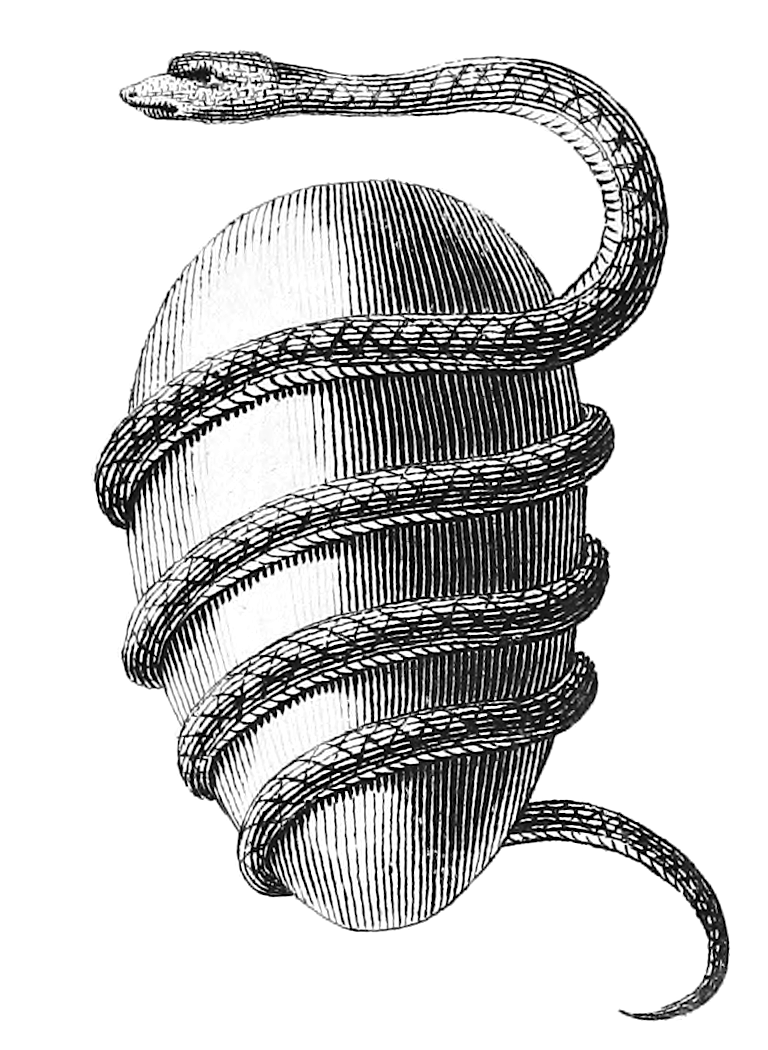
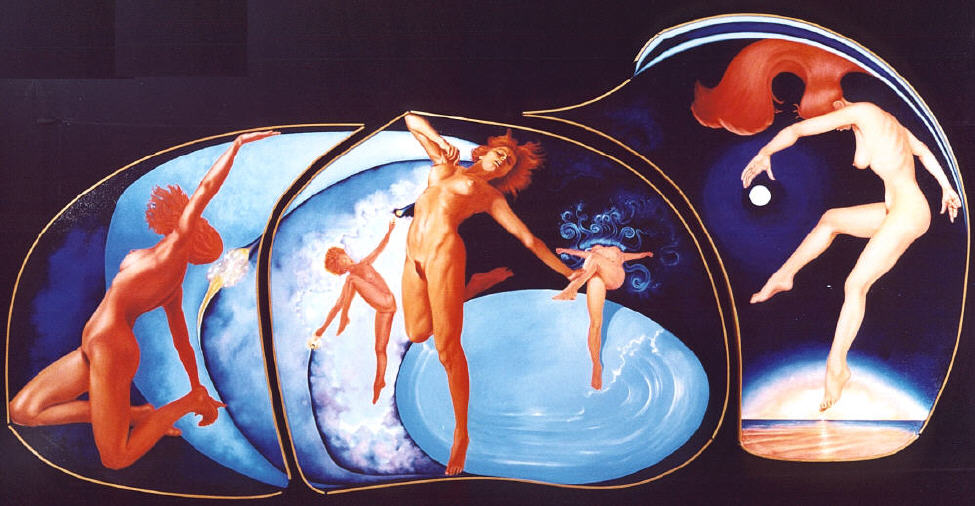
So Eurynome, the supreme creatitrix of all things, rises from Chaos and decides that she wants to dance on the waves.  Dance! So, she splits the sky and sea.  While shes dancing, she catches the wind in her hand and rubs it together between her palms, creating Ophion, the serpent.  Well, Eurynome has the hots for the serpent, and therefore turns into a dove and sleeps with him.  After this, she lays a Cosmic Egg.  She orders Ophion to wrap himself around the egg 7 times to incubate it. 

After doing this, the egg splits in half, releasing everything in existence today-  except people.  Ophion starts to get pretty boastful of his creation, and Eurynome doesn't like the lack of spotlight.  So, she kicks Ophion out of Mount Olympus, scattering his teeth in the process.  And, from these teeth came the Pelasgains! 


There where some cool overlaps in this story in relation to other creation myths.  The 7-day process seemed to occur quite often- not jut in the Genesis version.  Also, the use of the serpent seems to be pretty popular as well.  Something I found different about this story was the fact that a godDESS was the creator.  In most stories, a god or male creator does all the work. GIRL POWER!

Monday, September 9, 2013

In Illo Tempore

Once upon a time,
In the beginning,
the time before time began...

This was in illo tempore, before the first memory that I can recall.  It is crazy to think of everything that came before the time we had out first memory.

My first memory was the day I got potty-trained.  Its weird, I know.  But for some reason I remember the day vividly.  It was Easter, and we were dying eggs.  Suddenly, I decided that I would not ruin another pull-up and sprinted to the bathroom.  I took care of business, and that was it. And that is my memory.

In class we discussed that the past always possesses the present.  In a way, I guess that first memory was pretty important to my present!   We often forget how vital the little epics of our pasts are.

Therefore, mythology and all its pieces must still be important to the way we live, talk, learn, and create.

Wednesday, September 4, 2013

Trees have all the answers

The tree-hugging assignment got me thinking about the importance of origins.

In a way, trees can answer the root (pun not intended) question of this class, "Where did it all begin?"

If we go back to Genesis, we find the story/myth of the garden of Eden, which contained the tree bearing the fruit of knowledge of good and evil.  What took place there with Adam, Eve, and the serpent is considered the beginning of the fall of man.  The first sin that occurred under the branches of the tree defined the course of mankind forever.


A tree is truly the Axis Mundis.  It bore the knowledge of GOD.  How much more of an earth-heaven connection can you get? It is the center of beginnings. Good AND evil.

Trees have been around forever.  Their size, type, and location can tell us tons of things about the past that we were not around to experience.  They stay constant while their surroundings change.  

I am typing up this blog under a tree. On a laptop.


30 years ago, this would have never been possible.  However, this tree has seen books being read, cellphones first answered, and now, blogs posted.
 

Monday, September 2, 2013

First Thoughts

I am a bit late on posting, however, I've also had a lot of time to think about what we have discussed in class so far.  

Mythology has never really been taken too seriously.  Yes, there are allusions to its many stories and lessons, but lets be honest with ourselves- no one takes a Mythologies class to brush up on the accurate details of greek and roman history.  

One might even argue that studying myth can be fun.

We, and the rest of the scholars from the time these stories came about, were and are still intrigued with what they have to say, and why the ancient authors told them.

So on that note, lets have fun with this class.  Lets discover why these myths have remained so integral to todays literature, history, and culture. And perhaps, we can answer the question,

Where did it all begin?